News

We received this update from our Lobbyist Kevin Cummingham of Southern Strategy Group providing an update on the current session.
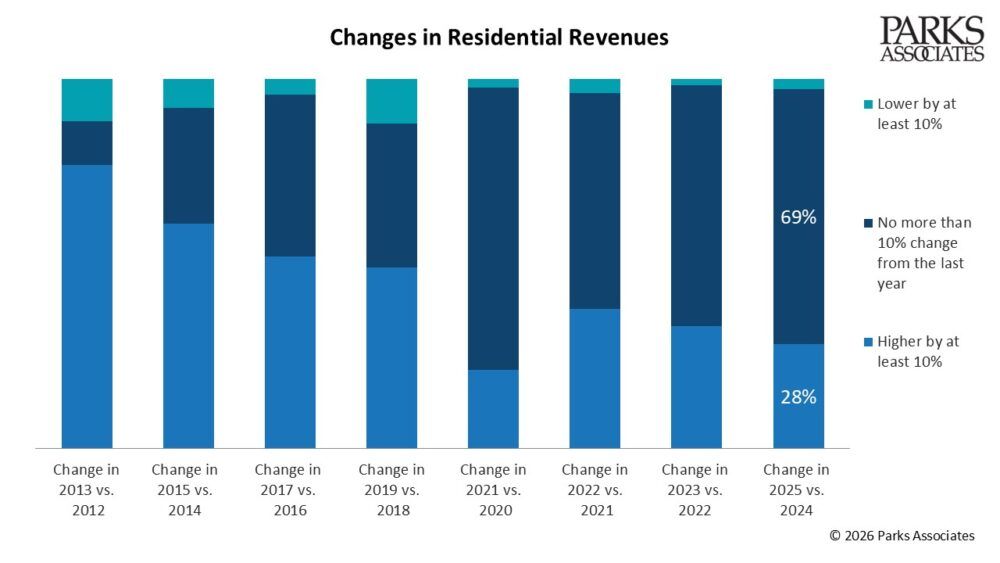
The security and life-safety industry continues to demonstrate resilience, but it is also evolving quickly. New research from Parks Associates shows that dealers across North America are balancing strong long-term fundamentals with shifting customer expectations, technology disruption, and economic pressures. For Louisiana contractors working in fire alarm, access control, video surveillance, and monitoring, these trends are not theoretical—they are already shaping how systems are designed, sold, installed, and serviced. Strong Industry Fundamentals Remain in Place Despite inflation concerns and tighter consumer spending, the security market remains stable. Installation activity has rebounded after pandemic disruptions, household system ownership is recovering, and demand for connected systems continues to grow. This stability is important for companies operating under Louisiana’s Life Safety and Property Protection licensing structure. It confirms that professionally installed systems—and the technicians who support them—remain central to the security ecosystem. However, stability does not mean stagnation. Growth expectations have moderated compared to earlier years, with most dealers anticipating changes within about plus or minus ten percent annually rather than rapid expansion. Video, AI, and Smart Devices Are Driving System Design One of the most significant shifts across the industry is the move toward video-driven security platforms and AI-enabled services. Dealers are increasingly integrating analytics, smart home technologies, and automation into traditional intrusion systems. For Louisiana integrators, this reinforces the importance of staying current on: video analytics platforms cloud-connected systems remote service capabilities hybrid intrusion/video deployments Customers now expect systems that deliver intelligence—not just alarms. DIY Competition Is Real—but Professional Installation Still Matters DIY security continues to expand, creating competitive pressure in the residential market. At the same time, the research confirms that professional dealers remain essential because they provide system integration, monitoring reliability, compliance expertise, and lifecycle service support. This is especially true in Louisiana, where licensing requirements help preserve professional standards and protect consumers. Companies that emphasize code compliance, monitoring partnerships, and long-term service relationships maintain a clear advantage over retail-driven alternatives. Commercial Security Is Becoming a Major Growth Engine Across the dealer channel, diversification into commercial work is one of the most important strategies for maintaining revenue growth. Many companies are expanding services beyond residential intrusion into access control, video surveillance, and integrated systems. For LLSSA members, this aligns directly with opportunities in: schools and campuses healthcare facilities industrial environments critical infrastructure municipal and parish projects Commercial expansion also strengthens recurring monitoring revenue and service agreements. Digital Sales and Automation Are Reshaping Operations Another key trend is operational modernization. Dealers are increasingly using digital tools for proposals, scheduling, remote diagnostics, and customer engagement. These efficiencies help address one of the industry’s biggest challenges: workforce availability. Companies that streamline workflows can scale more effectively without increasing overhead at the same rate. Consolidation Continues Across the Industry Investment activity and acquisitions remain common as larger organizations pursue scale in what is still a fragmented market. Independent dealers remain competitive by focusing on: local relationships service responsiveness code expertise regional knowledge association involvement This is where organizations like LLSSA play a critical role in strengthening the voice of locally owned companies. Why This Matters for Louisiana Professionals The takeaway from this research is clear: the dealer channel remains strong, but success depends on adaptation. Companies that invest in training, embrace emerging technologies, expand commercial capabilities, and stay engaged with their state association will be best positioned to grow in the years ahead. Louisiana’s licensing framework already sets a high professional standard. Staying connected through LLSSA ensures that integrators not only keep pace with industry change—but help shape the future of the life-safety and property-protection profession in our state.
We received this update from our Lobbyist Kevin Cummingham of Southern Strategy Group providing an update on the current session.
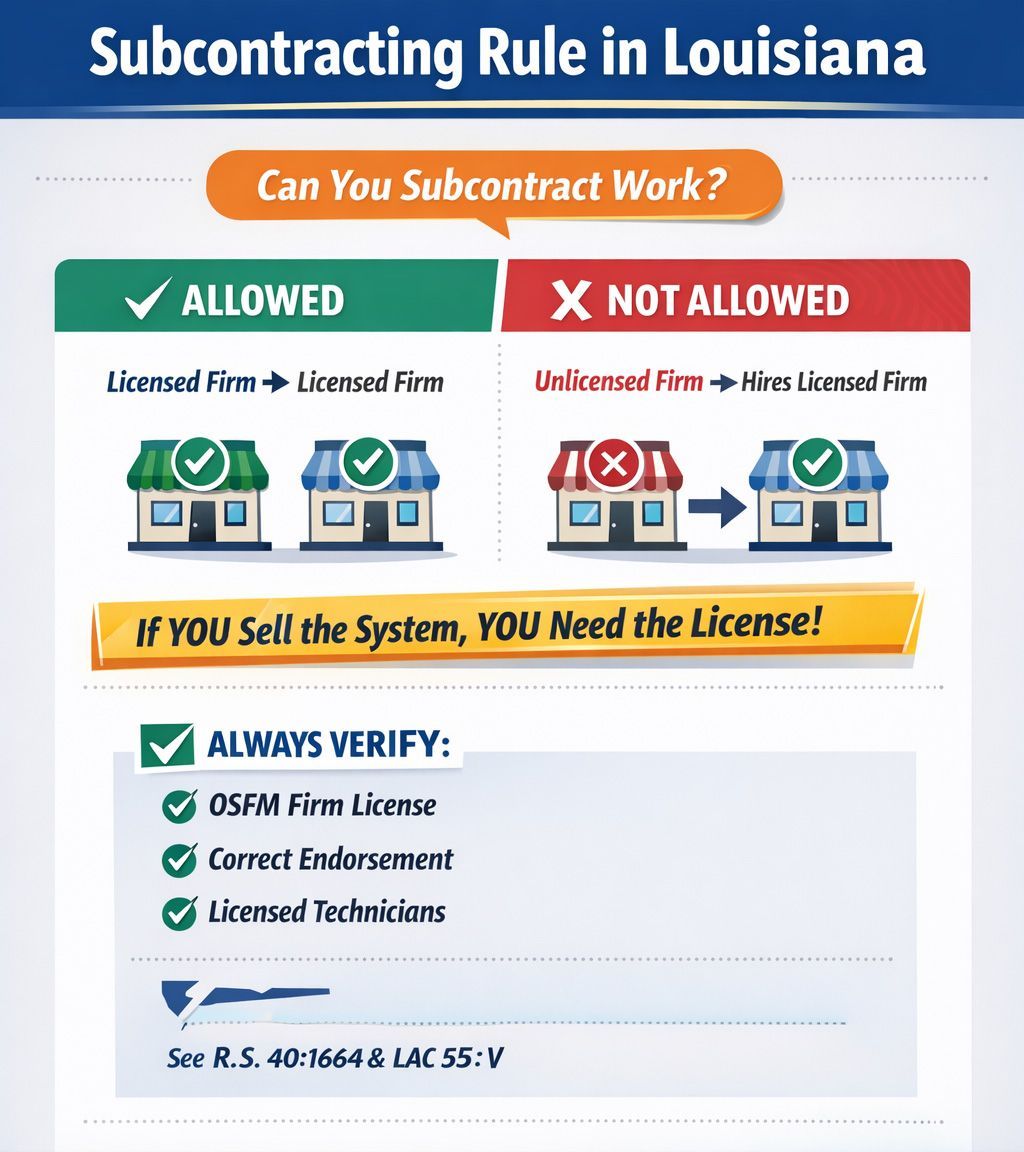
A common question among companies working in Louisiana’s life safety and property protection industry—fire alarm, fire suppression, security, CCTV, access control, and locksmith—is whether a company can subcontract work to another firm, particularly if the company itself is not licensed for that specific type of work. Under Louisiana law, any person or firm that engages in the business of installing, servicing, selling, or maintaining life safety or property protection systems must be licensed by the Louisiana Office of State Fire Marshal (OSFM). This requirement is established under Louisiana Revised Statutes Title 40 §1664 and related provisions, which govern the licensing of firms and individuals working in the life safety and property protection industry. The law requires that firms performing regulated work hold the appropriate license and endorsement for the specific type of system involved, and that the individuals performing the work also hold the required technician licenses. Because of this structure, subcontracting does not eliminate the licensing requirement. If a company advertises, sells, or signs a contract for regulated work—such as installing a fire alarm system—it is considered to be engaging in that regulated activity and must hold the appropriate license and endorsement issued by the State Fire Marshal. In practical terms, this means a company cannot sell or contract for work in a category for which it is not licensed and then simply subcontract the work to another company that is licensed. For example, a company licensed only for security systems cannot sell a fire alarm installation project and subcontract the work to a licensed fire alarm contractor unless the company itself also holds the fire alarm endorsement. Subcontracting is permitted when both firms involved hold the appropriate licenses and endorsements for the work being performed. For example, a licensed fire alarm company may subcontract installation work to another licensed fire alarm company, or a licensed security company may subcontract certain work to another properly licensed security firm. In these cases, the technicians performing the work must be properly licensed and must be working under the licensed firm that employs them. Louisiana Administrative Code provisions governing life safety licensing also prohibit license holders from allowing others to use or “borrow” their license, reinforcing that each company must maintain its own compliance. These requirements exist to ensure that companies offering life safety and property protection services meet the standards established by the State Fire Marshal, including maintaining proper insurance, employing qualified personnel, and being accountable for the work performed. The licensing structure is designed to protect the public and ensure that systems intended to protect life and property are installed and serviced by qualified professionals. In short: subcontracting is allowed in Louisiana’s life safety and property protection industry, but only when the companies involved are properly licensed for the specific type of work being performed. A company cannot bypass licensing requirements by subcontracting regulated work to another firm. For LLSSA members, the best practice when subcontracting is to verify that the subcontracting company holds a valid OSFM firm license, the correct endorsement for the work being performed, and properly licensed technicians. This helps ensure compliance with Louisiana law and protects both companies involved in the project.

The Louisiana Life Safety & Security Association (LLSSA) is proud to announce a new partnership with Anna4PAWS, expanding LLSSA’s ongoing commitment to supporting law enforcement K-9 teams across Louisiana. This initiative builds on LLSSA’s successful 2024 program that raised funds and distributed K-9 trauma kits to Louisiana K-9 units, further strengthening protections for these working dogs and their handlers. Through this partnership, LLSSA and Anna4PAWS will raise funds specifically for medical kits designed for K-9 officers—dogs that serve on the front lines of public safety in tracking, detection, and protection roles. These kits provide critical, potentially lifesaving care in the event a K-9 is injured while on duty. The expansion reflects a continued focus on practical, field-ready support for those who protect our communities every day. Life safety and property protection professionals across the country are invited to participate by supporting the program through LLSSA. Donations may be made as a one-time contribution, with 100% of funds going directly to Anna4PAWS and Louisiana K-9 units, or through the “Club 65” program, which allows supporters to give just $6.50 per month to provide ongoing assistance. Details and donation links can be found at the LLSSA K-9 Trauma Kit Donations page at https://llssa.org/k9-trauma-kit-donations/. This page includes secure online giving options as well as additional information about Anna4PAWS and their mission. “Our industry is built around protecting lives and property, and that mission aligns perfectly with supporting the K-9 officers who put themselves in harm’s way alongside their handlers,” said LLSSA leadership. “This partnership with Anna4PAWS allows our members and industry partners to make a direct, meaningful impact for Louisiana K-9 teams.” In 2024, LLSSA successfully distributed K-9 trauma kits to Louisiana agencies, demonstrating the tangible impact industry support can make. This expanded partnership ensures that effort continues—providing both immediate resources and sustained funding to keep K-9 teams equipped and protected.
Professionals in the life safety and property protection industry often move between states or expand their businesses across state lines. In recent years, Louisiana has taken steps to make it easier for qualified professionals licensed in other states to obtain a Louisiana license through a process commonly referred to as reciprocal licensing. This opportunity was strengthened with the passage of Louisiana’s “Welcome Home Act,” which allows individuals with qualifying out-of-state licenses to apply for licensure in Louisiana under specific conditions. For installers and companies working in areas such as fire alarm systems, security systems, and fire extinguisher services, licensing in Louisiana is administered through the Louisiana Office of the State Fire Marshal (OSFM). The OSFM regulates life safety and property protection professionals under Louisiana law to ensure that those installing and servicing critical systems meet the state’s training, experience, and ethical standards. Understanding the Welcome Home Act Louisiana’s Welcome Home Act was designed to help skilled professionals relocate to the state and begin working more quickly if they already hold valid credentials elsewhere. Under this law, individuals who hold an occupational license from another state may qualify for Louisiana licensure if the scope of their existing license is substantially similar to the requirements established in Louisiana. This process does not automatically grant a license; instead, it allows the Louisiana licensing authority to review the applicant’s credentials and determine eligibility for reciprocity. Basic Eligibility Requirements To be considered eligible for licensing under the Welcome Home Act through the State Fire Marshal’s Office, applicants must meet the following criteria: Hold a current and valid occupational license or certification from another state in a field with a similar scope of practice. Have held the out-of-state license or certification for at least one year. Have completed the education, examination, training, or experience requirements required by the issuing state. Be in good standing with the issuing state. Have no disqualifying criminal record, as determined by Louisiana law. Have no pending disciplinary actions or investigations in another state. Pay all applicable Louisiana licensing fees. If an applicant has a pending disciplinary matter in another state, the Louisiana licensing authority cannot issue or deny the license until that matter has been resolved. Louisiana Residency Requirement Applicants must also demonstrate that they reside in Louisiana. Acceptable proof of residency may include one of the following: A Louisiana-issued identification card A Louisiana voter registration card Documentation of current employment in Louisiana or a notarized promise of employment (for the applicant or their spouse) A Louisiana homestead exemption If residency is based on a promise of employment, additional documentation confirming Louisiana residency will be required within six months of licensure. Documentation Required for Review Applicants seeking reciprocity should be prepared to provide: Proof of their current out-of-state license or certification Documentation of relevant work experience Proof of Louisiana residency Any supporting documentation related to education or training The licensing authority will review these materials to determine whether the applicant meets Louisiana’s licensing standards. Where to Start the Process Professionals seeking reciprocal licensing should begin by contacting the Louisiana State Fire Marshal’s Licensing Division. Louisiana Office of State Fire Marshal - https://marshal.la.gov Licensing information - https://marshal.la.gov/Divisions/Fire-Protection/Licensing Applicants may also review Louisiana statutes governing life safety and property protection professionals through the **Louisiana State Legislature website - https://legis.la.gov How the LLSSA Can Help The Louisiana Life Safety & Security Association (LLSSA) regularly assists professionals entering the Louisiana market by helping them understand licensing requirements, continuing education expectations, and industry standards. Members of the LLSSA also gain access to training programs, CEU opportunities, and networking with experienced Louisiana professionals who can help new companies successfully operate within the state’s regulatory framework. If your company currently holds licenses in another state and is considering expanding into Louisiana, the LLSSA can help guide you through the process. Learn more about the association at - https://llssa.org Louisiana maintains one of the strongest licensing frameworks in the country for life safety and property protection professionals. While the Welcome Home Act makes it easier for qualified professionals from other states to obtain licensing, applicants must still demonstrate that their experience and credentials meet Louisiana’s standards. For companies looking to expand into Louisiana, understanding the process early—and working closely with the State Fire Marshal’s Office and industry organizations like LLSSA—can help ensure a smooth transition into the Louisiana market.
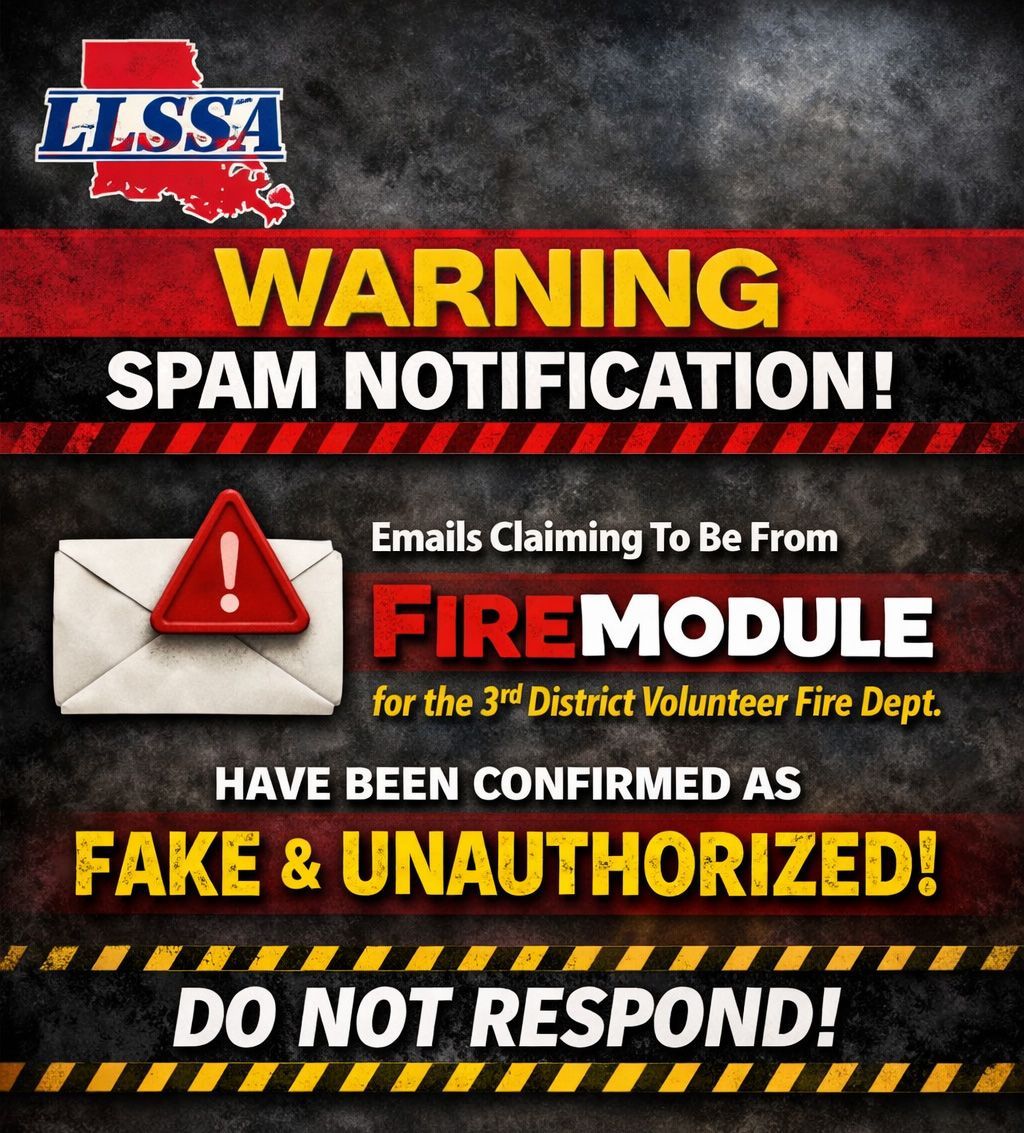
Recently, several members of the Louisiana Life Safety & Security Association (LLSSA) have reported receiving emails from a company identifying itself as “FireModule” claiming to act on behalf of the 3rd District Volunteer Fire Department in Louisiana. These messages instruct alarm and fire protection contractors to create accounts and submit inspection reports through a third-party portal, warning that failure to comply could result in non-compliance being reported to the Authority Having Jurisdiction (AHJ). After reviewing these communications and conducting follow-up inquiries, LLSSA reached out to the appropriate authorities to verify the legitimacy of the request. According to both the 3rd District Fire Chief and the Louisiana Office of the State Fire Marshal (SFMO), these notifications are not authorized requirements and have been identified as spam communications. There is currently no known law, ordinance, or directive requiring contractors working within the district to submit inspection reports through a FireModule portal. The emails appear designed to create a sense of urgency by labeling the message as an “Official Notification” and including language suggesting enforcement actions for non-compliance. In reality, inspection reporting requirements for fire protection systems in Louisiana are governed through established regulatory channels and recognized codes and standards. Contractors should always verify any new reporting requirements with the local Authority Having Jurisdiction or with the State Fire Marshal’s Office before creating accounts or providing company information to third-party systems. If you or your company receive a similar email requesting that you create a FireModule account or submit inspection reports through their platform, do not comply with the request until the matter is verified through official channels. Instead, members are encouraged to forward the message or report the incident to the Complaint Division of the Louisiana State Fire Marshal’s Office so the issue can be investigated and addressed. LLSSA will continue to monitor this situation and share updates with members if additional information becomes available. Protecting the integrity of our industry and ensuring that contractors are not subjected to unauthorized compliance demands is an important part of maintaining Louisiana’s high professional standards in the life safety and property protection field. If you have received similar notices or have questions about inspection reporting requirements, please notify the SFMO Complaint Division and consider informing LLSSA so we can continue to track reports from the field.
Discover New Skills and Connections at the 2026 AFAA Annual Fire Expo If you’re looking to grow your expertise, expand your professional network, and stay ahead of industry trends, make plans now to attend the 2026 Annual Fire Expo hosted by the Automatic Fire Alarm Association (AFAA). This premier event takes place April 14–16, 2026, at the Hilton Indianapolis Hotel & Suites in Indianapolis, Indiana. The AFAA Annual Fire Expo is one of the most valuable gatherings for fire alarm, emergency communications, and life safety professionals. As the only not-for-profit association dedicated exclusively to the fire alarm industry, AFAA brings together installers, inspectors, designers, manufacturers, and industry partners for three days of education, networking, and innovation. Attendees can earn 10+ hours of continuing education credits, participate in in-depth sessions on codes, standards, and best practices, and hear from industry thought leaders about emerging technologies and business strategies. Whether you’re looking to strengthen your technical skills, learn how artificial intelligence is shaping fire detection and signaling, or explore ways to enhance your business performance through data and service insights, the Expo delivers practical knowledge you can use on the job. Perhaps just as important is the opportunity to connect with peers and vendors face-to-face. The Expo’s networking events, receptions, and exhibit hall provide an ideal environment to share ideas, find new solutions, and build relationships with professionals from across the country. For Louisiana system installers and life safety contractors, this is a chance to bring fresh perspectives back to your team and customers. Investing in your professional development helps your business stay competitive, compliant, and prepared for the evolving demands of life safety and fire protection. The AFAA Annual Fire Expo is designed to help you do just that — grow your skills, broaden your network, and return home with insights that elevate your work and your company. To learn more and register, visit the official Annual Fire Expo page on the AFAA website. 2026 Annual Fire Expo | Automatic Fire Alarm Association
We received this update from our Lobbyist Kevin Cummingham of Southern Strategy Group providing an update on the upcoming session. Leading up to and during the 2026 Louisiana Regular Legislative Session, we will bring you this short synopsis of highlights from recent political news. Louisiana Gov. Jeff Landry has named State Rep. Julie Emerson as his new chief of staff, following the departure of Kyle Ruckert from that position. Following President Trump’s endorsement of Congresswoman Julia Letlow in Louisiana’s Senate race, Gov. Landry has also begun engaging in the race in favor of Letlow, firing critiques at incumbent GOP Sen. Bill Cassidy on social media in recent weeks. According to The Advocate’s report : “No Louisiana governor has opposed an incumbent senator from the same political party since 1932…” Louisiana Secretary of State Nancy Landry has initiated a statewide campaign for the transition to closed party primaries. The secretary is also overseeing a $100 million replacement of 35-year-old voting machines. KEY LEGISLATIVE DATES · Friday, Feb. 27 at 5 p.m. - Deadline to prefile most bills. · Monday, March 9 at noon - Start of the 2026 Regular Legislative Session. · Saturday, March 28 at 6 p.m. - Deadline for bills to be introduced. · Monday, June 1 at 6 p.m. - Final adjournment of the 2026 Regular Legislative Session.