News

We received this update from our Lobbyist Kevin Cummingham of Southern Strategy Group providing an update on the current session.
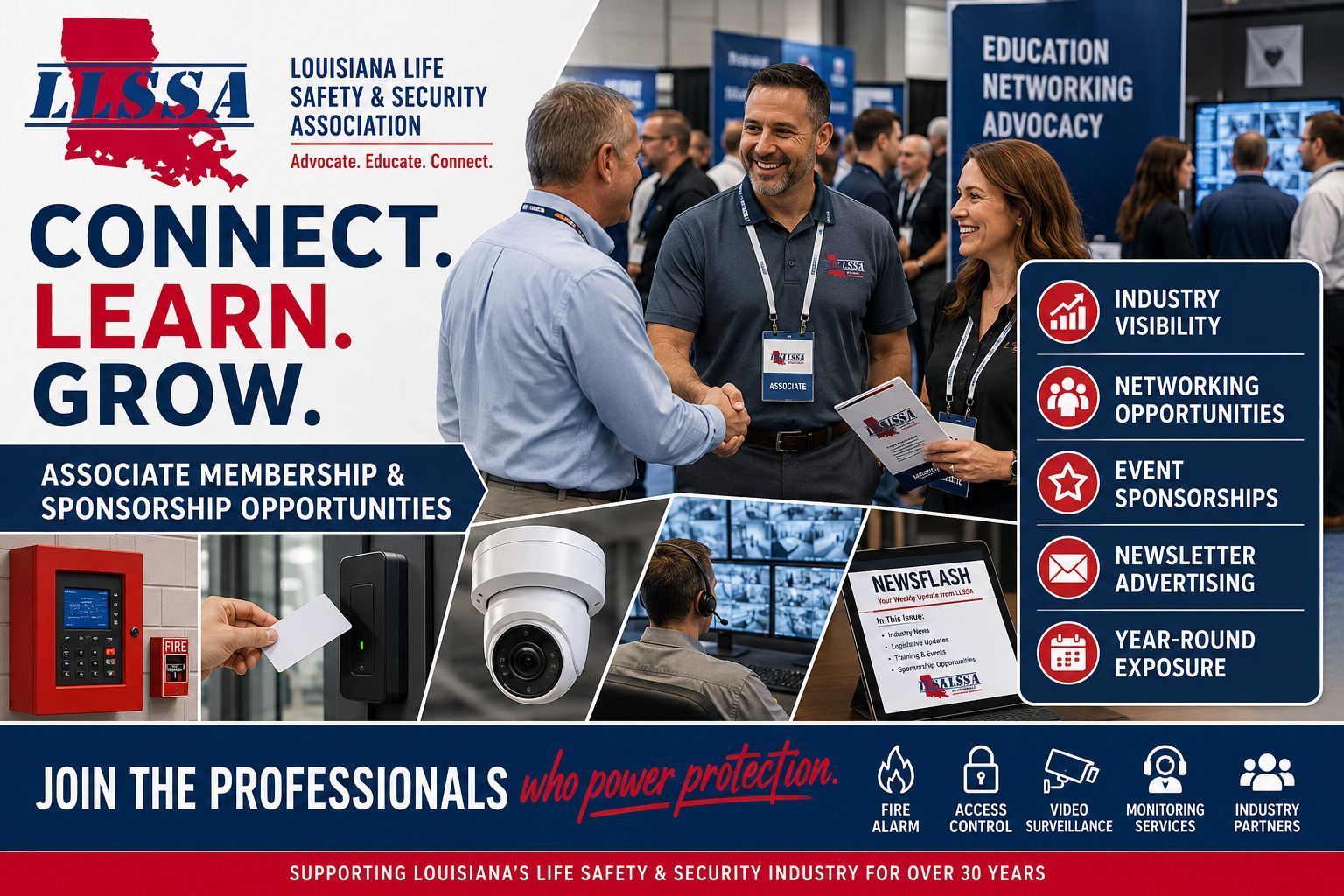
For manufacturers, distributors, monitoring centers, software providers, service partners, and industry suppliers, success is not just about having a great product or service—it is about building relationships, staying visible, and becoming a trusted resource within the industry. That is where Associate Membership in the Louisiana Life Safety & Security Association (LLSSA) delivers real value. As Louisiana’s leading trade association for the life safety and security industry, LLSSA provides direct access to the professionals, companies, and decision-makers who influence purchasing decisions and industry growth throughout the state. ( llssa.org ) More Than a Membership: Investing in Visibility, Relationships, and Growth Through LLSSA In today’s competitive marketplace, companies serving the life safety and property protection industry need more than a sales call or a marketing campaign to build lasting business relationships. They need opportunities to connect directly with the professionals who install, design, monitor, maintain, and manage life safety and security systems throughout Louisiana. That is exactly what Associate Membership in the Louisiana Life Safety & Security Association (LLSSA) provides. LLSSA has spent more than three decades supporting Louisiana’s life safety and security industry through education, advocacy, networking, and professional development. While regular members benefit from training, legislative representation, and industry resources, associate members gain something equally valuable—direct access to the companies and professionals who rely on their products and services every day. Associate members receive ongoing visibility through LLSSA meetings, events, email communications, and association resources. Their company name, logo, and website are promoted to members throughout the year, helping build recognition and credibility within the Louisiana market. Associate members also have opportunities to participate in committees, attend meetings, network with industry leaders, and contribute to the future direction of the industry. However, the greatest value often comes from taking advantage of one of LLSSA’s Associate Sponsorship Packages. Rather than purchasing individual sponsorships and advertising opportunities throughout the year, these packages bundle multiple events and promotional opportunities into a single annual investment. This allows companies to maximize their exposure while reducing overall marketing costs. The LLSSA sponsorship packages provide access to some of the association’s most successful events, including the Annual Convention, Dealer Conference, Regional Meetings, webinars, trade shows, golf events, and continuing education programs. Sponsors are placed in front of business owners, managers, qualifiers, technicians, and decision-makers who actively influence purchasing and partnership decisions within their organizations. In addition to event sponsorships, package participants receive valuable advertising opportunities through LLSSA’s communication channels. Weekly newsletters such as NewsFlash and the Training School newsletter place company messaging directly into the inboxes of Louisiana life safety and security professionals. These newsletters reach members who are actively engaged in running their businesses, managing operations, and pursuing continuing education. Another advantage of sponsorship participation is increased brand recognition. Consistent visibility throughout the year helps establish trust and familiarity with members. When a company’s name is regularly seen at conferences, regional meetings, webinars, newsletters, and educational events, it becomes associated with industry involvement and support. That recognition often translates into stronger relationships and new business opportunities. The annual sponsorship packages are designed to provide flexibility for companies of all sizes. Whether a business wants to focus on educational presentations, exhibit opportunities, advertising, networking events, or a combination of all three, there is a package designed to help maximize return on investment while simplifying annual marketing planning. LLSSA’s mission is to support and strengthen Louisiana’s life safety and security industry. Associate members and sponsors play a critical role in that mission by helping provide the educational programs, networking opportunities, and industry resources that members depend on throughout the year. At the same time, sponsors receive meaningful opportunities to grow their business and strengthen relationships within the industry. If your company serves the life safety, security, fire alarm, access control, video surveillance, locksmith, monitoring, or systems integration markets, now is the time to consider how Associate Membership and an annual sponsorship package can help you expand your reach in Louisiana. The companies that gain the most value from their membership are often the ones that actively participate, stay visible, and take full advantage of the opportunities LLSSA provides. Associate Membership is more than a dues payment—it is an investment in industry relationships, professional visibility, and long-term business growth.
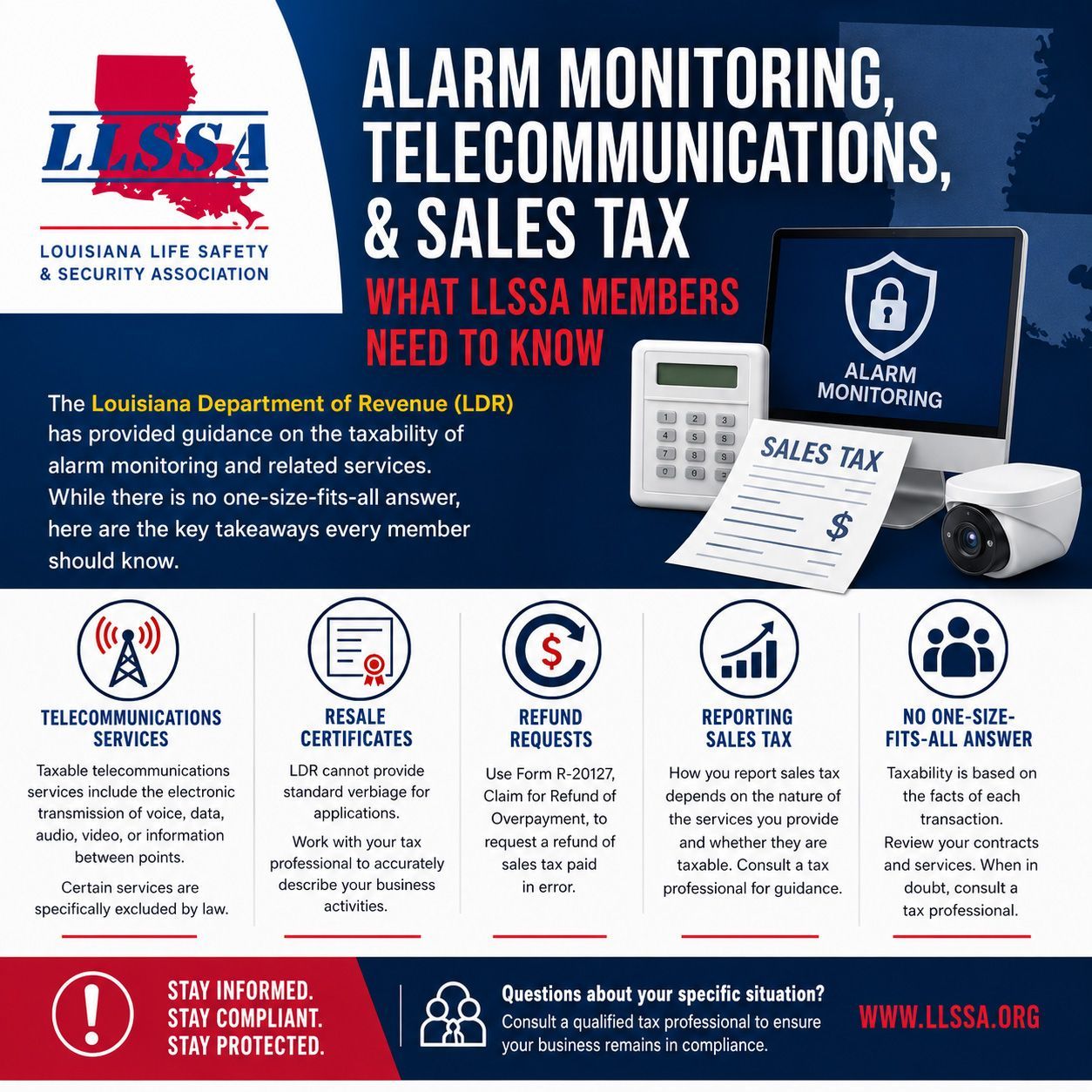
The Louisiana Life Safety & Security Association (LLSSA) has recently received several questions from members regarding the applicability of Louisiana sales tax to alarm monitoring and related services. To help clarify the issue, LLSSA reached out directly to the Louisiana Department of Revenue (LDR) for guidance. While LDR was unable to provide a blanket determination that applies to every monitoring company, the department did provide important information that every life safety and property protection professional in Louisiana should understand. Why There Is No One-Size-Fits-All Answer According to the Louisiana Department of Revenue, sales tax is a transactional tax. This means that the taxability of a service depends on the specific facts and circumstances of each transaction. As a result, LDR cannot issue a broad ruling that all alarm monitoring services are either taxable or non-taxable. Instead, each company must evaluate its own services, contracts, billing practices, and customer agreements to determine whether sales tax applies. Because of these complexities, LDR recommends consulting a qualified tax professional for guidance specific to your business. Understanding Telecommunications Services One of the key issues for alarm companies is whether a service falls within Louisiana's definition of a taxable telecommunications service. Under Louisiana Revised Statute 47:301(27)(x), telecommunications services generally include the electronic transmission, conveyance, or routing of voice, data, audio, video, or other information between points. The definition also includes services that utilize computer processing applications to facilitate the transmission or routing of information, regardless of how the service is classified by the Federal Communications Commission. However, the statute specifically excludes several categories from the definition of telecommunications services, including: Data processing and information services Installation of wiring or equipment on customer premises Maintenance of wiring or equipment on customer premises Tangible personal property Advertising services Billing and collection services provided to third parties Internet access services Radio and television programming services Ancillary services Digital products Prepaid calling and prepaid wireless calling services Because many alarm monitoring arrangements involve a combination of equipment, communication pathways, software platforms, and operator services, determining taxability often requires a careful review of exactly what is being sold to the customer. Resale Certificates and Application Challenges Several LLSSA members have reported difficulty obtaining resale certificates and have been informed that sales tax may not be required for their particular operations. LLSSA asked LDR whether specific language could be recommended for resale certificate applications. LDR declined to provide standardized wording, explaining that each business operates differently and that a broad determination cannot be made regarding the activities of all alarm companies. Members who are applying for resale certificates should work with their accountant or tax advisor to ensure the application accurately reflects their specific business activities and services. Refund Requests For businesses that believe sales tax may have been paid in error, LDR advises using Form R-20127, Claim for Refund of Overpayment. Members considering a refund request should carefully review their circumstances with a tax professional before filing to ensure the claim is supported by the facts of their particular situation. Reporting Sales Tax Collected LLSSA also asked how alarm companies should report sales tax collected on monitoring services after members reported difficulties completing their sales tax returns. Again, LDR emphasized that reporting requirements depend on the nature of the services being sold and whether those services are ultimately determined to be taxable. Because each company's contracts and service offerings may differ, LDR declined to provide general filing instructions applicable to all alarm companies. The department recommends consulting a qualified tax professional to determine the proper reporting method for each business. LLSSA Takeaway The most important message for Louisiana life safety and property protection companies is that there is currently no blanket determination from the Louisiana Department of Revenue regarding the taxability of alarm monitoring services. Every company should: Review its service offerings and customer agreements. Consult a qualified tax professional familiar with Louisiana sales tax law. Ensure resale certificate applications accurately describe business activities. Verify proper tax collection and reporting procedures. Consider whether refund opportunities may exist if taxes were previously paid in error. LLSSA will continue monitoring this issue and sharing information as additional guidance becomes available. Members with specific tax questions should seek advice from their tax professional, as the answers may vary significantly depending on the details of their business operations.
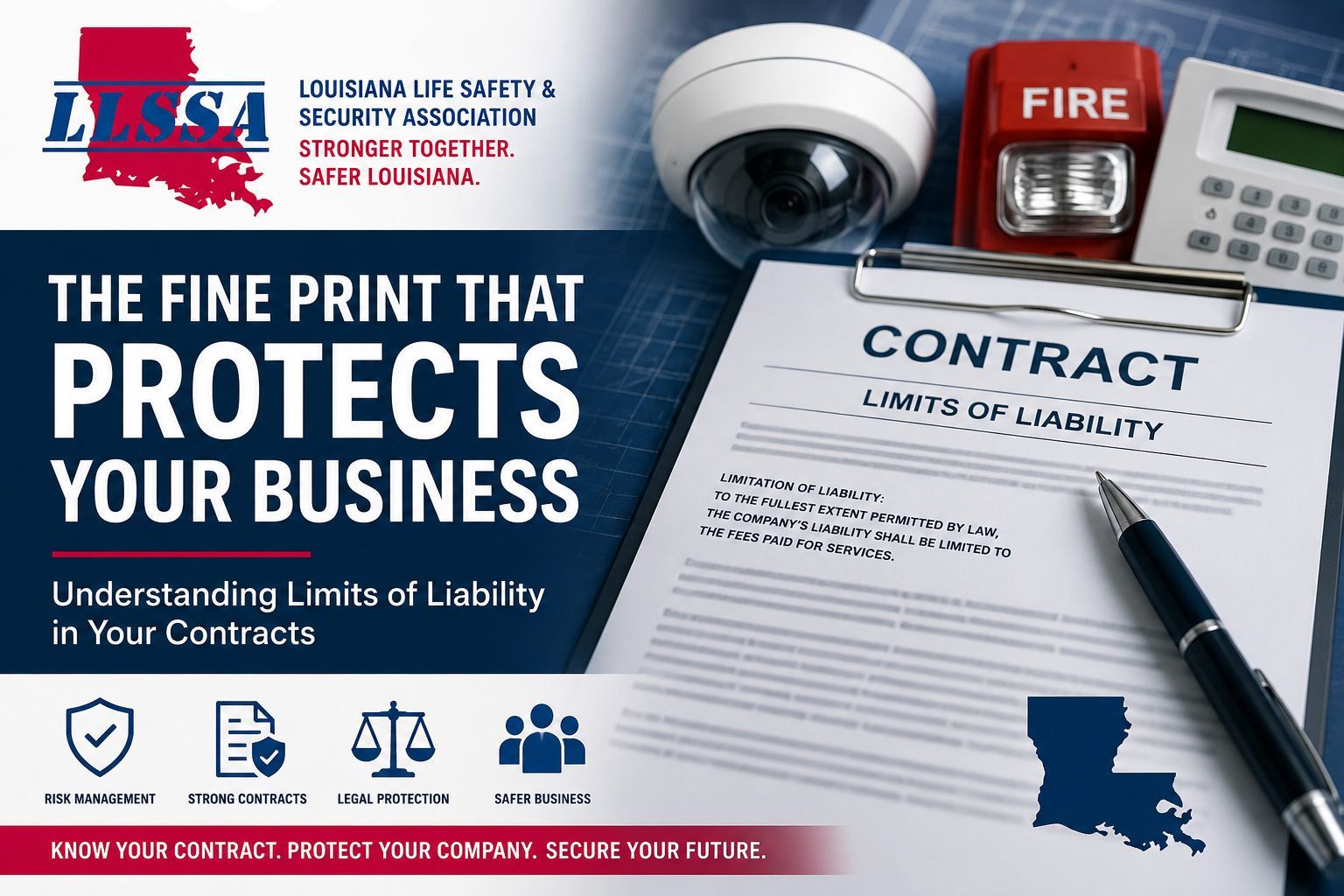
In the life safety and property protection industry, contracts are more than paperwork — they are one of the most important tools a company has to manage risk. While many alarm companies focus on pricing, scope of work, and payment terms, one of the most critical sections of any agreement is often buried deep in the document: the “limits of liability” clause. For Louisiana alarm installers, monitoring providers, locksmiths, fire alarm contractors, and integrated systems companies, understanding this section can make the difference between surviving a lawsuit and facing devastating financial exposure. A limits of liability clause is intended to define and restrict the amount of financial responsibility a company may have if a system fails, a signal is missed, equipment malfunctions, communication paths fail, or damages occur after an incident. Alarm systems, fire alarm systems, access control systems, cameras, and monitoring services are designed to reduce risk — not guarantee that losses will never happen. Even the best-designed and best-maintained systems can be defeated by power failures, communication outages, acts of nature, improper use, criminal activity, or customer negligence. Because of this, contracts typically include language that limits damages to a specified amount, often tied to the value of the services provided. Without these protections, a company installing a few thousand dollars’ worth of equipment could potentially face claims involving hundreds of thousands — or even millions — of dollars in damages following a burglary, fire, or other event. Plaintiffs often argue that the alarm company should bear responsibility for losses even when the system was not intended to act as an insurance policy or guarantee against every possible outcome. Properly written limitation of liability language helps establish realistic expectations between the company and the customer while reducing the risk of catastrophic claims that could threaten the survival of a business. It is also important for Louisiana companies to understand that simply having a contract is not enough. The wording matters. Courts may interpret contract language differently depending on how clauses are written and whether they comply with state law. Certain provisions may not be enforceable if they are vague, overly broad, improperly presented, or conflict with Louisiana law. A contract downloaded from the internet or copied from another company may not provide the protections a business owner assumes it does. In some cases, older contracts may not reflect current technology, modern communication methods, updated industry practices, or evolving legal standards. Alarm companies should also pay close attention to related provisions that often work together with limitation of liability language. These may include indemnification clauses, waiver of subrogation provisions, disclaimers of warranties, liquidated damages clauses, inspection and testing acknowledgements, force majeure language, and customer responsibilities regarding system maintenance and communication services. The interaction between these provisions can significantly impact how a claim is handled after an incident occurs. Another common mistake is failing to use the same contract consistently across all parts of the sales and installation process. Quoted proposals, work orders, change orders, monitoring agreements, electronic signatures, and verbal promises made by sales staff can all create confusion if they conflict with the primary contract terms. Training salespeople and technicians to avoid making guarantees or statements outside the contract is just as important as the language inside the document itself. For Louisiana life safety and property protection companies, this is also a reminder to review state laws and licensing requirements that may impact contractual obligations. Certain projects, especially those involving fire alarm systems, monitoring, and commercial installations, may carry additional legal responsibilities. Business owners should work with an attorney familiar with the electronic security and life safety industry to regularly review and update their agreements. Industry-specific legal counsel can help ensure contracts reflect current laws, address emerging technologies, and properly allocate risk in a way that protects the company while maintaining fair customer relationships. A strong contract cannot prevent every lawsuit, but it can significantly improve a company’s ability to defend itself when disputes arise. In an industry built around protecting people and property, protecting your own business should remain a priority as well.

Artificial intelligence is rapidly changing the hiring process across nearly every industry, including the life safety and property protection field. Today, many applicants are using AI tools to help write resumes, customize cover letters, prepare for interviews, and search for job opportunities faster than ever before. At the same time, employers are increasingly using applicant tracking systems (ATS), automated screening tools, and AI-driven recruiting platforms to sort through applications and identify qualified candidates. For Louisiana life safety and property protection companies, this shift creates both opportunities and challenges. Companies struggling to find qualified technicians, salespeople, inspectors, and office staff can benefit from AI-assisted recruiting tools that help streamline hiring and identify stronger candidates more efficiently. However, employers should also recognize that AI-generated resumes and applications can sometimes appear polished while lacking real-world technical knowledge or industry experience. In a field where licensing requirements, code compliance, background checks, and hands-on technical skills are critical, hiring managers must continue to verify qualifications carefully and rely on interviews, references, and practical evaluations—not just impressive resumes. AI can also be a valuable tool for your company’s own recruiting efforts. Businesses can use AI to draft job descriptions, identify important keywords that improve online job visibility, organize applicant communications, and even help target candidates with transferable skills from related trades. Some platforms now help employers compare resumes against job requirements more efficiently, reducing administrative workload for smaller companies without dedicated HR departments. At the same time, the most successful companies will continue to focus on the “human” side of hiring. Industry experience, professionalism, customer service skills, dependability, and willingness to learn remain essential qualities that no AI system can fully measure. In Louisiana’s life safety industry—where technicians often work directly with customers, AHJs, and the State Fire Marshal’s Office—personal reputation and trust still matter. AI may help improve the recruiting process, but strong company culture, mentorship, training, and professional development remain the key to building a successful workforce for the future.

House Bill 917 by Daryl Deshotel has passed the Louisiana Senate and will be sent to the Governor for signature. This legislation proposes one of the most significant updates in recent years to Louisiana’s licensing framework for life safety and property protection companies and personnel regulated by the Office of the State Fire Marshal (OSFM). The bill is currently being monitored for the Louisiana Life Safety & Security Association (LLSSA) by Kevin Cunningham of Southern Strategy Group (SSG). If enacted, HB 917 would modernize licensing timelines, adjust background-check requirements, clarify exemptions, and update administrative procedures affecting alarm, fire, locksmith, suppression, sprinkler, extinguisher, and related endorsement holders statewide. A Shift to Three-Year Licenses One of the most impactful provisions extends license validity from one year to three years for both firms and individuals. This change reduces renewal frequency and administrative workload for license holders while shifting fees into a multi-year structure rather than annual payments. According to the Legislative Fiscal Office, the adjustment may reduce yearly processing volume but consolidate payments into larger renewal cycles and slightly increase overall self-generated revenue for the OSFM. For contractors and technicians, this represents a meaningful administrative improvement—fewer renewal deadlines, fewer interruptions, and better long-term credential stability. Background Check Requirements Narrowed HB 917 limits mandatory criminal background checks to principals, officers, and designated qualifiers. This change reduces regulatory burden and cost for licensed firms while maintaining screening requirements for those in positions of responsibility over compliance and operations. The bill also establishes conditions under which out-of-state employees providing remote technical support may work without Louisiana licensure if background-check standards are met and reporting requirements are followed. Administrative Personnel Exempted from Licensure The legislation formally exempts administrative personnel—defined as employees performing clerical, scheduling, or office support functions who do not visit protected premises—from licensing requirements. This clarification aligns regulatory expectations with actual job roles inside licensed firms and removes unnecessary licensing obligations for non-technical staff. Provisional Licenses Eliminated HB 917 repeals the State Fire Marshal’s authority to issue provisional licenses. While this removes a pathway previously used by some applicants entering the field, it also simplifies the licensing structure and aligns credential issuance more closely with completed qualification requirements. Updated Renewal and Expiration Rules The bill introduces clearer renewal timing and stricter expiration consequences: Licenses become invalid immediately if not renewed before expiration. A 15-day grace period is allowed without penalty. After that period, late fees of up to $125 may apply. Licenses expired more than one year require full reapplication and a new background check. These provisions emphasize proactive license management and reinforce compliance expectations across the industry. Remote Technical Support Recognized HB 917 acknowledges modern service delivery models by allowing certain out-of-state employees to provide remote technical support without Louisiana licensure, provided they pass background checks and meet reporting obligations. This change reflects how monitoring centers, programming teams, and technical specialists increasingly operate across state lines while supporting Louisiana-licensed firms. Fee Structure and Classification Updates The bill revises fee schedules for firm and employee endorsements and removes outdated classifications, including the definition of “door hardware specialist,” to better reflect current industry practice. It also allows licenses tied to certifications or credentials to expire automatically when those credentials lapse, strengthening alignment between qualification status and authorization to work. What This Means for LLSSA Members HB 917 represents a modernization effort that touches nearly every licensed segment of Louisiana’s life safety and property protection industry. If enacted, members may see: fewer annual renewal cycles reduced background-check requirements for employees clearer exemptions for administrative staff recognition of remote technical support roles stricter expiration and reinstatement timelines updated licensing classifications and procedures Taken together, these changes streamline compliance while preserving the structure of Louisiana’s nationally recognized licensing system. The LLSSA Legislative Committee and Southern Strategy Group will continue tracking HB 917 as it moves through the Senate and will notify members if amendments are adopted that affect implementation timelines or licensing requirements.
House Bill 565, authored by Dixon McMakin, has now been signed by the Governor as ACT 166. The legislation proposes targeted updates to how fire safety requirements are applied to early learning centers and child day care facilities and clarifies the authority of the Louisiana State Fire Marshal in enforcing those requirements. The bill was monitored on behalf of the Louisiana Life Safety & Security Association (LLSSA) by its legislative partner, Kevin Cunningham of Southern Strategy Group (SSG). While HB 565 is narrowly focused on childcare occupancies, it carries broader implications for code enforcement expectations and regulatory consistency across institutional occupancies that matter to contractors, designers, and service providers working in Louisiana’s life safety and property protection industry. What HB 565 Does HB 565 amends Louisiana Revised Statute 40:1563 to clarify several aspects of fire safety inspections and enforcement for early learning centers and child day care facilities. Specifically, the bill: Confirms the State Fire Marshal’s responsibility for inspection oversight of early learning centers and child day care centers. Limits enforcement to requirements expressly contained in adopted state or federal fire and life safety codes, rather than interpretations or policy guidance outside those codes. Requires that fire safety requirements be proportional to the size, occupancy, and risk level of the facility. Clarifies that standard residential appliances (such as microwaves and coffee makers) do not automatically trigger commercial suppression or ventilation requirements unless explicitly required by code. Requires written notice citing specific code provisions for any violations or corrective actions. Establishes a 15-day appeal window through the Division of Administrative Law for parties contesting determinations. Stays enforcement actions, penalties, or closure orders while appeals are pending. Places the burden of proof on the State Fire Marshal to demonstrate that a requirement is authorized by adopted codes. Why This Matters to the Industry Although the bill applies directly to early learning centers and child day care occupancies, its emphasis on code-based enforcement—not policy interpretation—reflects a broader legislative interest in ensuring regulatory clarity and consistency. For life safety and property protection professionals, this reinforces several important operational expectations: Code-based enforcement remains the standard. HB 565 explicitly affirms that requirements must be tied to adopted state or federal life safety codes. This supports predictable compliance pathways for contractors and system designers. Risk-based application of requirements is emphasized. The legislation clarifies that facilities should not automatically be treated like commercial or industrial occupancies unless required by code. That distinction may influence future discussions around occupancy classification and proportional system requirements. Documentation standards are strengthened. Requiring written notice with specific code citations improves transparency during inspections and helps contractors respond more efficiently to compliance issues. Appeal protections are clarified. The bill provides a defined administrative appeal process and pauses enforcement actions during review, which may affect project timelines and compliance strategies when disputes arise. What This Means for LLSSA Members For installers, integrators, and service providers working in education and childcare environments, HB 565 may help reduce uncertainty around interpretation-driven requirements and reinforce reliance on adopted codes such as NFPA standards as implemented by Louisiana authorities having jurisdiction. More broadly, the bill signals continued legislative attention to how fire safety requirements are applied in licensed institutional occupancies. As similar issues occasionally arise in other regulated facility types, this approach could shape future policy discussions affecting the life safety and property protection sector. The LLSSA Legislative Committee and Southern Strategy Group will continue monitoring HB 565 as it moves through the Senate and will provide updates if amendments or implementation considerations affect member companies. LLSSA remains committed to supporting policies that maintain Louisiana’s position as the national “Gold Standard” for life safety and property protection licensing while ensuring requirements remain clear, consistent, and rooted in adopted codes.
We received this update from our Lobbyist Kevin Cummingham of Southern Strategy Group providing an update on the current session.

In the life safety and property protection industry, even the best-designed and professionally installed system can fail to perform as intended when the end user misuses, disables, ignores, or improperly maintains it. Unfortunately, when an incident occurs, the installing or monitoring company is often the first target for blame. That is why strong contracts, clear documentation, and consistent customer communication remain some of the most important risk-management tools available to Louisiana licensees. A common issue across the industry involves customers changing system settings, bypassing devices, failing to maintain equipment, ignoring trouble conditions, or refusing recommended repairs. In some cases, users may disconnect communication paths, allow batteries to fail, or neglect required inspections and testing. When an alarm or fire system later does not operate as expected, disputes can arise over responsibility. Industry legal experts continue to stress that properly written contracts and thorough records are a company’s best defense in these situations. For Louisiana companies, this reinforces the importance of detailed agreements that clearly define the responsibilities of both the provider and the customer. Contracts should explain system limitations, required maintenance obligations, testing expectations, monitoring procedures, communication path requirements, and the consequences of disabling or failing to service equipment. Documentation is equally important. Service records, inspection reports, customer signatures, deficiency notices, emails, and recommendations for repair or replacement can become critical evidence if questions arise later. Technicians and salespeople should also avoid creating unrealistic expectations. No alarm, fire, access control, or video system can guarantee prevention of loss, injury, or damage. Systems are designed to reduce risk and provide notification, but they depend heavily on proper use, maintenance, communication paths, and timely response by occupants and emergency personnel. Clear communication with customers about what a system can—and cannot—do helps reduce misunderstandings and liability exposure. Another important practice is documenting customer refusals. If a customer declines repairs, ignores inspection deficiencies, refuses recommended upgrades, or requests that portions of a system remain disabled, that decision should be documented in writing. A signed acknowledgment can help demonstrate that the company identified the issue and informed the customer of the potential risk. Training employees on documentation practices is just as important as technical training. Every employee interacting with customers should understand the importance of accurate notes, complete work orders, and professional communication. A poorly documented service call can become a major issue years later if litigation occurs. In today’s environment of increasing litigation and higher customer expectations, contracts should not be treated as “just paperwork.” They are a critical business protection tool. Working with qualified legal counsel familiar with the life safety and property protection industry can help ensure agreements properly address liability limitations, customer responsibilities, monitoring terms, inspection requirements, and dispute procedures. For LLSSA members, this is another reminder that professionalism extends beyond installation quality. Strong operational procedures, consistent documentation, and clear contracts help protect both the customer and the company when problems arise.