News
The False Alarm Reduction Association (FARA) Annual Symposium, held April 14–16, 2026, in Tucson, Arizona, brought together law enforcement leaders, monitoring professionals, technology providers, and industry associations from across the country to collaborate on one of the life safety industry’s most important shared goals: reducing false alarms. Representing the Louisiana Life Safety and Security Association (LLSSA), Chairman of the Board Dera DeRoche-Jolet attended the event and contributed to national discussions on verification technology and best practices developed by the alarm industry over the past four decades. The symposium featured 26 public-safety representatives from agencies spanning California to Maryland, highlighting the strong national interest in improving alarm response efficiency through cooperation between law enforcement and alarm professionals. Over three days, attendees participated in 15 hours of training sessions and joint industry–public safety events, reinforcing a consistent message: agencies are not adversaries of the alarm industry—they are partners working toward smarter response policies and improved outcomes for communities. Sessions addressed several emerging issues that directly affect alarm dealers and monitoring providers: False alarm trends and enforcement strategies Law enforcement false alarm reduction units shared practical insight into how agencies evaluate repeat alarm locations. A consistent finding across jurisdictions is that more than 98% of false alarms originate from preventable causes, including new employees unfamiliar with systems, building changes, after-hours access by staff such as teachers or church personnel, and temporary occupants like pet or house sitters. These findings reinforce the importance of user education and system training at installation and turnover. Self-monitored video response activity Departments discussed how jurisdictions are beginning to regulate calls generated by users viewing their own cameras and requesting police dispatch. As DIY and app-based monitoring continues to expand, agencies are evaluating ordinance updates to manage this evolving category of alarm requests. Mobile and wearable panic alarms Presenters highlighted the rapid expansion of panic activation methods—from wall buttons and under-counter devices to smartphones, smartwatches, and even automated crash or fall detection triggers. These technologies are changing expectations around emergency signaling and response workflows. Alarm billing software and ordinance enforcement tools Updates to municipal billing platforms demonstrated how agencies are improving tracking of permits, fines, and repeat activations through ordinance-driven automation. These tools are shaping how cities manage alarm programs and interact with alarm companies. Online payment processing risks and cybersecurity considerations One session examined a real-world incident involving an AI-driven bot attack that generated payment processing issues and associated card-network penalties. Agencies emphasized the importance of vendor vetting and contingency planning when implementing online payment platforms—an increasingly relevant issue for municipalities and industry partners alike. Manufacturers and monitoring providers presented tools designed to reduce unnecessary dispatch requests, including: Video verification platforms User-education tools such as FARA Alarm School Enhanced account setup and compliance workflows Software conversion strategies for agencies upgrading alarm program systems These solutions continue to reinforce the industry’s long-standing commitment to improving dispatch accuracy and response efficiency. During the symposium, Dera DeRoche-Jolet presented on the alarm industry’s 45-year evolution in false alarm reduction, highlighting advances in verbal, audio, and video verification technologies and the transition from legacy POTS signaling to cellular, IP, access control integration, GPS tracking, and modern camera-based verification systems. Her presentation emphasized the proactive steps alarm professionals have taken—and continue to take—to support public safety partners nationwide. Participation in events like the FARA Symposium ensures Louisiana’s life safety and property protection professionals remain engaged in shaping national best practices. As agencies refine policies and technology continues to evolve, the collaboration between law enforcement and alarm companies remains essential to protecting response resources and improving service to the communities we all serve.

We received this update from our Lobbyist Kevin Cummingham of Southern Strategy Group providing an update on the current session.

Across Louisiana and the broader life safety and property protection industry, many facilities still rely on legacy proximity (prox) cards for access control. While these credentials remain familiar and inexpensive, they increasingly represent a significant security and operational liability. For today’s integrators and installers, continuing to deploy or maintain legacy prox systems without discussing modernization options can expose both clients and companies to avoidable risk. Legacy prox cards were designed for a different era of access control—one where standalone door security was the primary objective. Modern environments now demand integrated identity management, cybersecurity awareness, mobile credentials and encrypted authentication. As expectations evolve, reliance on older credential formats can undermine system resilience and weaken an organization’s overall security posture. Traditional 125 kHz proximity cards typically lack encryption and transmit static credential data that can be easily copied using inexpensive tools. This makes credential cloning one of the most common vulnerabilities associated with legacy systems. Once duplicated, unauthorized individuals can gain facility access without detection, creating liability exposure for both the end user and the integrator responsible for system recommendations. In addition to cloning risks, prox credentials create operational limitations. They are often incompatible with newer identity platforms, enterprise security integrations and mobile credential ecosystems that organizations increasingly expect. As access control converges with IT, HR and risk management functions, outdated credential technologies can become a barrier to modernization rather than a foundation for it. Many decision-makers continue choosing prox cards because of their low upfront price. However, the long-term financial exposure can be far greater. If a breach occurs, organizations may face emergency re-credentialing costs, reader replacements, downtime, legal liability and reputational damage—all of which can far exceed the savings from inexpensive cards. For integrators, recommending legacy credentials without explaining these risks can also affect credibility. Clients increasingly expect their security providers to act as strategic advisors, not just equipment installers. When vulnerabilities emerge that could have been addressed earlier, trust can erode quickly. User expectations are shifting rapidly. Mobile credentials, touchless entry and centralized identity management are becoming standard features in many environments, particularly in healthcare, education, multifamily housing and enterprise facilities. Younger decision-makers and IT stakeholders often view legacy prox systems as outdated and misaligned with broader digital infrastructure strategies. At the same time, physical security systems are increasingly integrated with enterprise workflows. Studies indicate a growing percentage of organizations are coordinating access control with HR, facilities and risk management teams—making credential security part of a larger organizational strategy rather than a standalone function. For LLSSA member companies, legacy prox systems present an opportunity to deliver additional value—not just hardware upgrades. By proactively identifying credential vulnerabilities and discussing migration strategies, integrators can strengthen client relationships and position themselves as trusted advisors. Practical steps include: Evaluating existing credential technologies during service visits or system audits Discussing encryption-based smart cards or mobile credentials as upgrade paths Planning phased reader replacements instead of disruptive full-system swaps Coordinating with IT stakeholders when access control is part of a broader security strategy These conversations help clients move toward stronger security while reinforcing the integrator’s role as a long-term partner in protection. Access control is no longer just about opening doors—it is about managing identity, reducing risk and supporting enterprise-level security expectations. Legacy prox cards may still function, but they no longer represent best practice. For Louisiana’s life safety and property protection professionals, the takeaway is clear: identifying credential vulnerabilities early—and helping clients plan realistic upgrade paths—strengthens both system performance and professional credibility. In today’s threat environment, modernization isn’t optional. It’s part of delivering the level of protection clients expect.
We received this update from our Lobbyist Kevin Cummingham of Southern Strategy Group providing an update on the current session.
When seconds matter, the information available to a 9-1-1 call taker can make a critical difference. The Smart911 application is a free public-safety tool that allows residents and businesses to create a secure Safety Profile that automatically provides additional details to emergency dispatchers when they call 9-1-1. For Louisiana’s life safety and property protection professionals, Smart911 represents an important opportunity to help customers strengthen their emergency preparedness beyond the alarm panel. Smart911 allows users to create a Safety Profile that is displayed to participating 9-1-1 centers when a registered phone number calls for help. This profile can include addresses, medical conditions, emergency contacts, household members, pets, access instructions, and other details that responders may need before arriving on scene. Because dispatchers often receive limited information—especially from mobile callers—having pre-entered data available during an emergency can improve response accuracy and speed. Users control exactly what information they share. A Smart911 Safety Profile may include: Names and photos of household members Medical conditions, allergies, or medications Mobility limitations or disabilities Gate codes, hidden driveways, or access notes Emergency contacts and caregiver information Vehicle descriptions Pets and service animals Floor plans or location details for businesses ([Erie, CO][3]) This information is only displayed to authorized emergency personnel when a registered phone calls 9-1-1. Many alarm users assume monitoring centers and emergency dispatch already have detailed information about their homes or businesses. In reality, dispatchers often receive only a phone number and approximate location from a wireless call. Smart911 helps bridge that gap by ensuring responders know critical details immediately—even if the caller cannot communicate clearly due to stress, injury, or safety concerns. This can be especially valuable for: Seniors living alone Families with children Individuals with medical conditions Customers with disabilities or mobility challenges Businesses with after-hours access procedures Facilities with service animals or pets onsite ([New Castle County][6]) In many jurisdictions, Smart911 also provides opt-in emergency alerts such as severe weather warnings, evacuations, traffic incidents, and public safety notifications delivered by text, email, or voice message. These alerts help residents stay informed before and during emergencies—not just when they call 9-1-1. Life safety and property protection professionals are in a unique position to introduce Smart911 to customers during system installations, service visits, and monitoring discussions. Encouraging customers to create a Safety Profile reinforces the message that protection goes beyond equipment—it includes preparation, communication, and coordination with first responders. Smart911 is free to use, available nationwide in participating jurisdictions, and profiles travel with the user when calling 9-1-1 from registered phone numbers in supported areas. Creating a Smart911 Safety Profile typically takes only a few minutes, but the information it provides can help dispatchers send the right resources faster and more safely when an emergency occurs. For LLSSA members, recommending Smart911 is a simple way to extend the value of every system you install—and help protect the people and communities you serve.
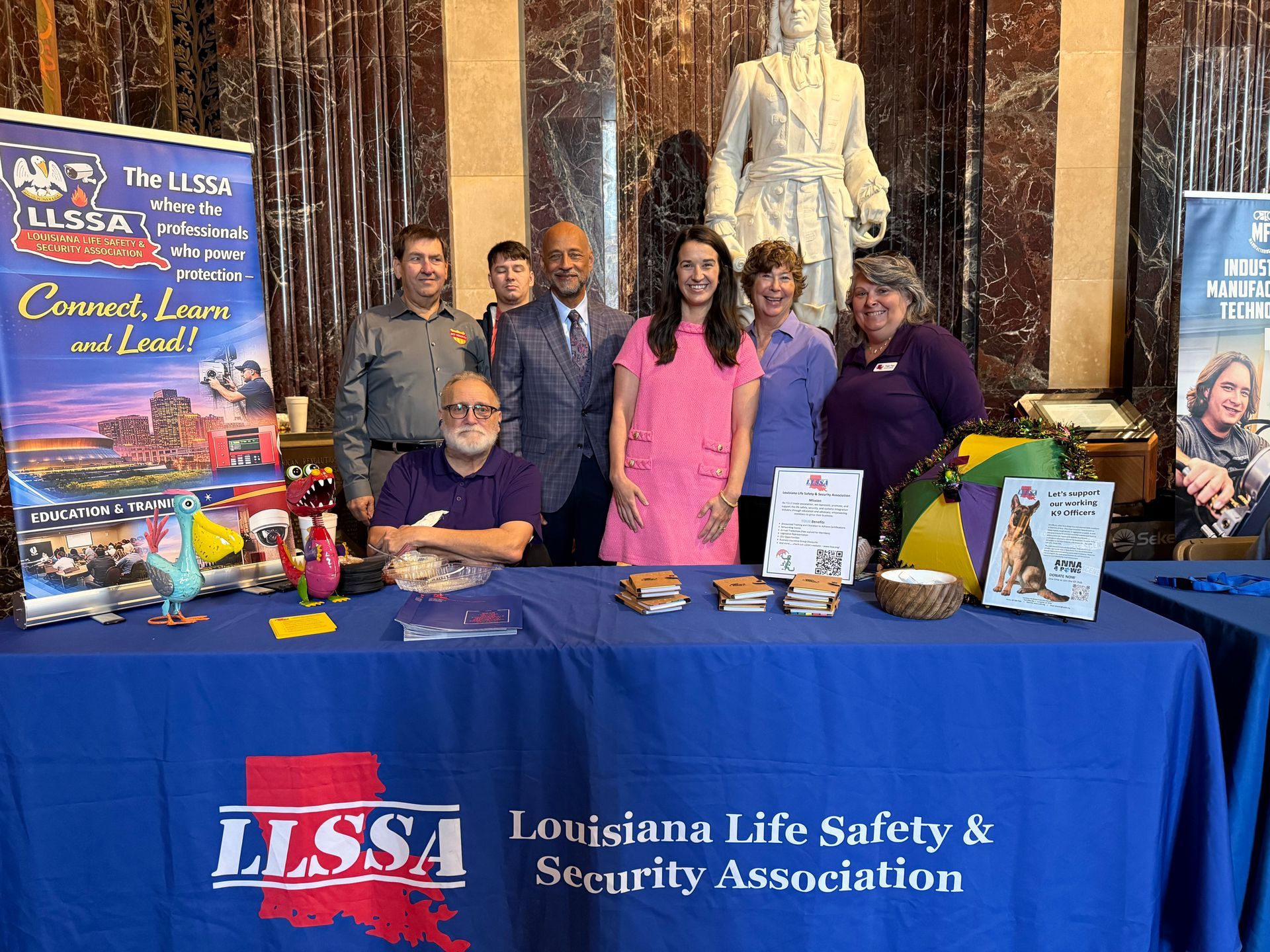
The Louisiana Life Safety & Security Association (LLSSA) hosted two successful spring events that highlighted the strength, engagement, and professionalism of Louisiana’s life safety and property protection community. From advocacy at the State Capitol to education and networking at the annual Dealer Conference, members demonstrated their commitment to protecting communities and advancing the industry statewide. On March 25, LLSSA members gathered at the Louisiana State Capitol in Baton Rouge for Capital Day, meeting directly with state legislators to discuss issues affecting life safety and property protection professionals across Louisiana. Members had the opportunity to meet with Vinny St. Blanc, Michael Melerine, Jack McFarland, Emily Chenevert, and Daryl Deshotel to share perspectives on licensing, public safety standards, and workforce development. Participants also observed a committee hearing and a Senate session, gaining valuable insight into the legislative process and how policy decisions impact the industry. The visit produced immediate results—Representative Deshotel followed up with LLSSA leadership after the event to request input on House Bill 917, reinforcing the association’s role as a trusted resource for policymakers. Capital Day continues to be a cornerstone of LLSSA’s advocacy efforts, ensuring that the professionals who power protection across Louisiana have a voice in shaping the laws and regulations that affect their work and their customers. Shortly after Capital Day, LLSSA hosted its 11th Annual Dealer Conference, welcoming more than 200 attendees for a full day of education, collaboration, and networking. The conference on April 9th featured 14 CEU classes designed to help technicians, qualifiers, and company leaders stay current with licensing requirements, codes, and best practices. The event also included a bustling tradeshow with 33 vendors, offering attendees the opportunity to explore new technologies, strengthen partnerships, and connect with industry leaders supporting Louisiana’s life safety and property protection sector. A highlight of the conference was the popular Welcome Reception, where members and vendors gathered on the patio for an evening of conversation and friendly competition. Attendees enjoyed oversized Jenga and cornhole games while building relationships that support both business growth and industry collaboration. Together, Capital Day and the Dealer Conference reflect LLSSA’s ongoing mission to connect, educate, and advocate for the professionals who safeguard Louisiana’s homes, businesses, and communities. As the association continues its 2026 calendar of regional meetings, webinars, and training opportunities, member engagement remains stronger than ever.

Artificial intelligence is rapidly becoming part of the everyday toolkit for sales professionals across the life safety and property protection industry. From proposal development to pipeline management, AI can help integrators work faster and smarter—but it works best when paired with strong processes, clean data, and disciplined execution. In fact, organizations that adopt AI successfully tend to treat it as a productivity enhancer, not a replacement for relationship-driven selling. For LLSSA member companies, the opportunity is clear: use AI to create more time for customer interaction, improve proposal quality, and streamline internal workflows—while continuing to rely on the human expertise that differentiates trusted security professionals. 1. Start with Leadership Alignment AI adoption works best when leadership clearly supports the effort and sets expectations. Without direction from ownership and sales management, AI tools often get used inconsistently—or not at all. A coordinated strategy ensures that the technology supports business goals such as improving estimating accuracy, accelerating proposal turnaround, or strengthening forecasting discipline. For smaller integration firms especially, leadership commitment signals that AI is not just another experiment—it’s part of the company’s operational future. 2. Focus on What Salespeople Actually Need While executives may be excited about forecasting accuracy and reporting dashboards, most salespeople are motivated by something simpler: more time with customers and fewer administrative distractions. AI can assist with drafting emails, summarizing site notes, preparing proposals, and researching prospects—freeing up time for relationship-building and closing opportunities. That shift toward customer-facing activity is where the biggest gains typically occur. 3. Choose One High-Impact Starting Point Rather than attempting a full digital transformation overnight, successful organizations begin with one priority area. Common starting points include: Proposal and estimate generation RFP analysis outbound marketing support pipeline tracking and forecasting presentation development Selecting a single improvement area increases adoption and creates early wins that build confidence across the team. 4. Decide Between Integrated Platforms and Standalone Tools AI capabilities can be deployed through enterprise-level systems (such as CRM or ERP platforms with built-in automation) or through specialized “best-of-breed” tools that address one task at a time. Many organizations benefit from starting with targeted solutions before expanding into broader integrations later. This phased approach is especially practical for regional integrators and growing companies balancing modernization with day-to-day operations. 5. Measure Results Early and Often Like any operational improvement initiative, AI adoption should be tied to measurable outcomes. Track metrics such as: time required to generate proposals forecast accuracy number of customer meetings per week proposal conversion rates Monitoring performance over time helps confirm whether AI tools are delivering real value—or simply adding complexity. 6. Don’t Lose the Human Advantage As more communication becomes automated, personal interaction becomes more valuable—not less. Customers still want trusted advisors who understand their facilities, risks, and compliance requirements. Eye contact, site visits, and authentic conversations remain critical differentiators in the life safety and security industry. The most successful sales teams will use AI to handle repetitive tasks while investing more time in consultative selling and long-term customer relationships. AI is not replacing the professional security salesperson—it is strengthening the role. Companies that adopt these tools thoughtfully can respond faster to opportunities, produce stronger proposals, and spend more time helping customers solve real safety challenges. For Louisiana’s life safety and property protection professionals, the goal isn’t simply to adopt AI. It’s to adopt it in ways that reinforce expertise, improve efficiency, and keep trusted relationships at the center of every sale.
House Bill 917 by Daryl Deshotel has passed the Louisiana House of Representatives and is now under consideration in the Senate. This legislation proposes one of the most significant updates in recent years to Louisiana’s licensing framework for life safety and property protection companies and personnel regulated by the Office of the State Fire Marshal (OSFM). The bill is currently being monitored for the Louisiana Life Safety & Security Association (LLSSA) by Kevin Cunningham of Southern Strategy Group (SSG). If enacted, HB 917 would modernize licensing timelines, adjust background-check requirements, clarify exemptions, and update administrative procedures affecting alarm, fire, locksmith, suppression, sprinkler, extinguisher, and related endorsement holders statewide. A Shift to Three-Year Licenses One of the most impactful provisions extends license validity from one year to three years for both firms and individuals. This change reduces renewal frequency and administrative workload for license holders while shifting fees into a multi-year structure rather than annual payments. According to the Legislative Fiscal Office, the adjustment may reduce yearly processing volume but consolidate payments into larger renewal cycles and slightly increase overall self-generated revenue for the OSFM. For contractors and technicians, this represents a meaningful administrative improvement—fewer renewal deadlines, fewer interruptions, and better long-term credential stability. Background Check Requirements Narrowed HB 917 limits mandatory criminal background checks to principals, officers, and designated qualifiers. This change reduces regulatory burden and cost for licensed firms while maintaining screening requirements for those in positions of responsibility over compliance and operations. The bill also establishes conditions under which out-of-state employees providing remote technical support may work without Louisiana licensure if background-check standards are met and reporting requirements are followed. Administrative Personnel Exempted from Licensure The legislation formally exempts administrative personnel—defined as employees performing clerical, scheduling, or office support functions who do not visit protected premises—from licensing requirements. This clarification aligns regulatory expectations with actual job roles inside licensed firms and removes unnecessary licensing obligations for non-technical staff. Provisional Licenses Eliminated HB 917 repeals the State Fire Marshal’s authority to issue provisional licenses. While this removes a pathway previously used by some applicants entering the field, it also simplifies the licensing structure and aligns credential issuance more closely with completed qualification requirements. Updated Renewal and Expiration Rules The bill introduces clearer renewal timing and stricter expiration consequences: Licenses become invalid immediately if not renewed before expiration. A 15-day grace period is allowed without penalty. After that period, late fees of up to $125 may apply. Licenses expired more than one year require full reapplication and a new background check. These provisions emphasize proactive license management and reinforce compliance expectations across the industry. Remote Technical Support Recognized HB 917 acknowledges modern service delivery models by allowing certain out-of-state employees to provide remote technical support without Louisiana licensure, provided they pass background checks and meet reporting obligations. This change reflects how monitoring centers, programming teams, and technical specialists increasingly operate across state lines while supporting Louisiana-licensed firms. Fee Structure and Classification Updates The bill revises fee schedules for firm and employee endorsements and removes outdated classifications, including the definition of “door hardware specialist,” to better reflect current industry practice. It also allows licenses tied to certifications or credentials to expire automatically when those credentials lapse, strengthening alignment between qualification status and authorization to work. What This Means for LLSSA Members HB 917 represents a modernization effort that touches nearly every licensed segment of Louisiana’s life safety and property protection industry. If enacted, members may see: fewer annual renewal cycles reduced background-check requirements for employees clearer exemptions for administrative staff recognition of remote technical support roles stricter expiration and reinstatement timelines updated licensing classifications and procedures Taken together, these changes streamline compliance while preserving the structure of Louisiana’s nationally recognized licensing system. The LLSSA Legislative Committee and Southern Strategy Group will continue tracking HB 917 as it moves through the Senate and will notify members if amendments are adopted that affect implementation timelines or licensing requirements.
House Bill 565, authored by Dixon McMakin, has now passed the Louisiana House of Representatives and moved to the Senate for consideration. The legislation proposes targeted updates to how fire safety requirements are applied to early learning centers and child day care facilities and clarifies the authority of the Louisiana State Fire Marshal in enforcing those requirements. The bill is currently being monitored on behalf of the Louisiana Life Safety & Security Association (LLSSA) by its legislative partner, Kevin Cunningham of Southern Strategy Group (SSG). While HB 565 is narrowly focused on childcare occupancies, it carries broader implications for code enforcement expectations and regulatory consistency across institutional occupancies that matter to contractors, designers, and service providers working in Louisiana’s life safety and property protection industry. What HB 565 Does HB 565 amends Louisiana Revised Statute 40:1563 to clarify several aspects of fire safety inspections and enforcement for early learning centers and child day care facilities. Specifically, the bill: Confirms the State Fire Marshal’s responsibility for inspection oversight of early learning centers and child day care centers. Limits enforcement to requirements expressly contained in adopted state or federal fire and life safety codes, rather than interpretations or policy guidance outside those codes. Requires that fire safety requirements be proportional to the size, occupancy, and risk level of the facility. Clarifies that standard residential appliances (such as microwaves and coffee makers) do not automatically trigger commercial suppression or ventilation requirements unless explicitly required by code. Requires written notice citing specific code provisions for any violations or corrective actions. Establishes a 15-day appeal window through the Division of Administrative Law for parties contesting determinations. Stays enforcement actions, penalties, or closure orders while appeals are pending. Places the burden of proof on the State Fire Marshal to demonstrate that a requirement is authorized by adopted codes. Why This Matters to the Industry Although the bill applies directly to early learning centers and child day care occupancies, its emphasis on code-based enforcement—not policy interpretation—reflects a broader legislative interest in ensuring regulatory clarity and consistency. For life safety and property protection professionals, this reinforces several important operational expectations: Code-based enforcement remains the standard. HB 565 explicitly affirms that requirements must be tied to adopted state or federal life safety codes. This supports predictable compliance pathways for contractors and system designers. Risk-based application of requirements is emphasized. The legislation clarifies that facilities should not automatically be treated like commercial or industrial occupancies unless required by code. That distinction may influence future discussions around occupancy classification and proportional system requirements. Documentation standards are strengthened. Requiring written notice with specific code citations improves transparency during inspections and helps contractors respond more efficiently to compliance issues. Appeal protections are clarified. The bill provides a defined administrative appeal process and pauses enforcement actions during review, which may affect project timelines and compliance strategies when disputes arise. What This Means for LLSSA Members For installers, integrators, and service providers working in education and childcare environments, HB 565 may help reduce uncertainty around interpretation-driven requirements and reinforce reliance on adopted codes such as NFPA standards as implemented by Louisiana authorities having jurisdiction. More broadly, the bill signals continued legislative attention to how fire safety requirements are applied in licensed institutional occupancies. As similar issues occasionally arise in other regulated facility types, this approach could shape future policy discussions affecting the life safety and property protection sector. The LLSSA Legislative Committee and Southern Strategy Group will continue monitoring HB 565 as it moves through the Senate and will provide updates if amendments or implementation considerations affect member companies. LLSSA remains committed to supporting policies that maintain Louisiana’s position as the national “Gold Standard” for life safety and property protection licensing while ensuring requirements remain clear, consistent, and rooted in adopted codes.